
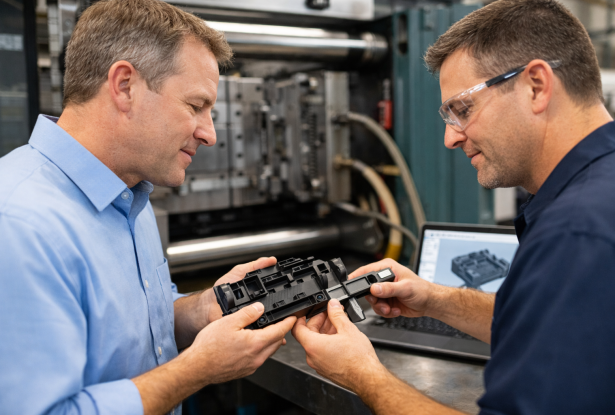
In high-precision manufacturing, consistency is everything. When producing complex components for demanding industries like automotive tier 2 assemblies, medical devices, and electronics, subtle variations in temperature, pressure, or cooling time can lead to costly quality issues. Common defects such as sink marks, splay, warpage, and short shots do not just disrupt production schedules; they compromise product integrity and drive up scrap rates.
Traditionally, machine operators addressed defects using a trial-and-error approach, making real-time adjustments based on visual observation or past experience. Today, modern plastic injection moulding relies on a far more rigorous methodology: scientific molding.
By shifting from intuitive machine adjustments to a data-driven, sensor-monitored process, plastic injection manufacturers can virtually eliminate defects and ensure reliable repeatability across long production runs.
What Is Scientific Molding?
Scientific molding is a structured, decoupled approach to process development and quality control in plastic injection molding. Rather than treating the injection molding machine, tool, and material as a single variable, scientific molding separates the process into discrete, measurable phases:
- Phase 1: Filling (Decoupled I) – The mold cavity is rapidly filled to approximately 95–98% using speed control, independent of pressure limits.
- Phase 2: Packing and Holding (Decoupled II) – Pressure control is applied to fully pack the part, compensating for material shrinkage as it begins to cool.
- Phase 3: Cooling and Plastication (Decoupled III) – The part cools in the mold while the screw rotates to prepare the next shot of molten polymer.
By utilizing cavity pressure sensors and strict data collection, engineers can measure what is actually happening inside the mold cavity rather than relying solely on machine-level hydraulic parameters.
How Scientific Molding Prevents Common Molding Defects
Controlling plastic behaviour at a molecular level allows engineering teams to directly address the root causes of component failure.
1. Eliminating Sink Marks and Voiding
The Issue: Thicker sections of a plastic part cool slower than thinner walls, causing internal stress and pulling surface material inward.
The Scientific Solution: By analyzing cavity pressure data, engineers determine the exact moment the gate freezes. Applying precise hold pressure until gate seal occurs prevents sink marks and internal voids without unnecessarily lengthening cycle times.
2. Preventing Warpage and Dimensional Instability
The Issue: Non-uniform cooling rates across a component cause uneven stress distribution, resulting in bent or twisted parts.
The Scientific Solution: Scientific molding uses volumetric filling studies and precise mold temperature control to ensure uniform wall pack and cooling rates. This keeps dimensions within tight tolerances—critical for multi-component assemblies.
3. Stopping Short Shots and Flash
The Issue: A short shot occurs when molten plastic fails to completely fill the cavity; flash happens when excess plastic escapes between parting lines.
The Scientific Solution: Decoupling the filling phase from the packing phase allows high injection speeds without overpressurizing the tool.
The Role of Tooling and Material Consistency
Scientific molding is only as reliable as the inputs surrounding it. Achieving zero-defect plastic manufacturing requires seamless coordination across tooling design, material selection, and processing setup:
- Design for Manufacturability (DFM): Analyzing wall thickness, draft angles, and gate locations early in the engineering phase reduces inherent process sensitivity.
- Tooling Integrity: High-quality tooling equipped with sensors allows monitoring of internal cavity conditions during every cycle.
- Material Management: Standardizing melt-flow behaviour and controlling resin moisture levels ensure consistent viscosity from lot to lot.
Partnering with an experienced plastic manufacturer that manages everything from early design support and tooling maintenance to final production ensures process variables remain fully controlled throughout the product lifecycle.
Precision and Process Control at Baytech Plastics
At Baytech Plastics, quality assurance is built into every stage of the plastic manufacturing workflow. With decades of experience serving demanding automotive tier 2, medical, industrial, and consumer electronics markets, we leverage automated systems, advanced machinery, and rigorous process monitoring to maintain tight tolerances and repeatable results.
By taking an engineering-led approach to continuous process improvement, we minimize scrap, optimize cycle times, and ensure your parts perform reliably in real-world applications.