
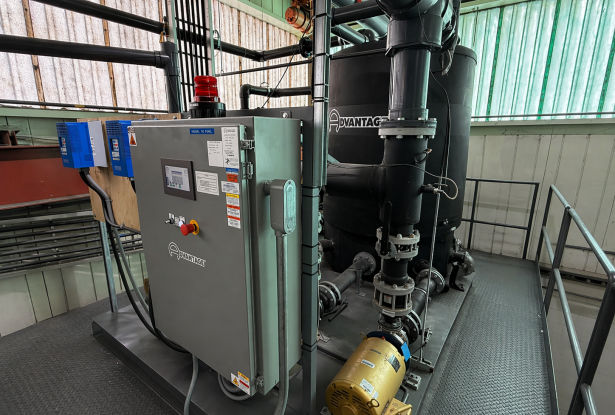
As part of a consolidation of two molding plants, we completed a major upgrade to our chilled water system — installing variable-speed pumps, a larger chilled-water tank, and upgraded piping and headers. The improved system allowed us to increase the number of machines in the plant while improving part performance, energy efficiency and lowering operating costs.
Why Chilled Water Performance Matters in Injection Molding
Consistent mold temperature is one of the most important variables in injection molding. Even small fluctuations or slow response times can affect cycle time, dimensional accuracy, surface finish, internal stresses and scrap rates. By improving the infrastructure that delivers cooling, we reduce process variability at the source.
How We Improved Our Chilled Water System
- Variable-frequency-drive (VFD) pumps to deliver chilled water at the flow and pressure required, ramping speed to match demand.
- Larger chilled-water tank to increase system capacity and buffer transient loads.
Upsized PVC piping and larger headers to reduce pressure drop and improve flow distribution to each mold circuit. - Corrosion-resistant piping that lowers maintenance and keeps heat transfer consistent.
Quality Improvements from Better Cooling Control
- Tighter temperature control — Faster, more stable response to setpoint changes reduces hot spots and temperature drift.
- Improved dimensional consistency — Stable mold temperature reduces warpage and part-to-part variation, improving first-pass yield.
- Better surface appearance — More even cooling minimizes sink, flow lines and other cosmetic defects.
- Lower scrap and rework — Reduced process variability leads to fewer rejects and less rework, which shortens lead times and cuts material waste.
- More predictable cycle times — Faster heat extraction enables more consistent cooling portions of cycles, improving throughput planning and uptime.
- Scaled production without compromise — The upgraded system supports a greater number of machines while maintaining the same tight process control needed for high-quality parts.
Energy Savings and Operational Efficiency Benefits
- Reduced pump energy: VFDs match pump speed to demand instead of running full speed continuously, cutting electrical consumption and peak loads.
- Lower system losses: Larger-diameter piping and properly sized headers reduce friction and head loss, so pumps operate more efficiently.
- Fewer chiller cycles: A larger buffer tank smooths transient loads so the chiller runs more steadily and less frequently, improving chiller efficiency and reducing wear.
- Lower maintenance and downtime: PVC piping and reduced stress on components mean fewer leaks, less corrosion and lower repair costs over time.
- Cost-effective expansion: Increasing machine count didn’t require proportional increases in chiller runtime or energy cost thanks to improved distribution and buffering.
Why This Upgrade Improves Long-Term Production Performance
This chilled-water upgrade — completed as part of consolidating two plants — isn’t just infrastructure work — it’s a quality and efficiency investment that directly improves the parts we deliver and lowers operating cost. Expect more consistent parts, fewer defects, better surface finish, more predictable production, and lower energy use across the shop floor.
If you are looking for a manufacturing partner focused on process control, efficiency, and consistent part quality, our team is ready to support your next program.