
Overview
In high-volume manufacturing, even small design changes can significantly impact cost, assembly time, and supply chain complexity. For one industrial water management application, Baytech Plastics worked with a customer to implement a nano-stake welding process that eliminated the need for traditional metal fasteners.
By replacing hardware with a molded joining method, the final assembly became lighter, simpler to manufacture, and more efficient to scale for long-term production.
The Challenge
The customer required a reliable way to secure multiple plastic components within a wastewater treatment product assembly. The original design relied on metal hardware to fasten parts together, which introduced several challenges.
Metal fasteners added cost to the bill of materials and required additional sourcing, inventory management, and assembly steps. Hardware also increased product weight, impacting shipping costs and handling efficiency. In addition, reliance on external metal components created potential supply chain risks that could affect production timelines.
The customer wanted a more streamlined approach that would reduce assembly complexity while maintaining structural integrity.
The Baytech Solution
Baytech’s engineering team evaluated the product design and recommended the use of a nano-stake welding process to permanently join the plastic components.
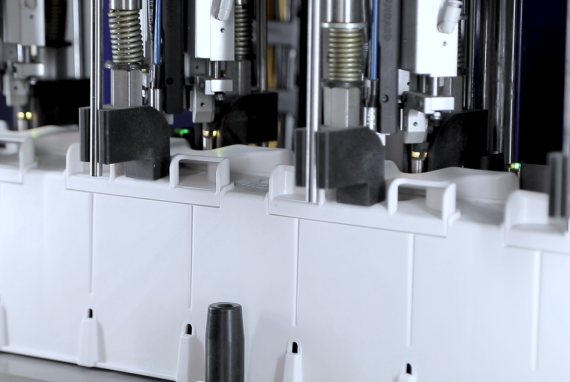
Nano-stake welding forms small molded posts within the plastic parts that are then heat-formed during assembly. These posts create strong mechanical bonds between components without the need for screws, inserts, or other hardware.
While implementing the process required an initial tooling and setup investment, the long-term production benefits quickly outweighed the upfront cost.
The revised design allowed multiple molded parts to be securely joined directly within the manufacturing process, simplifying assembly while maintaining performance requirements.
Results and Benefits
- Reduced Assembly Costs – Eliminating metal fasteners reduced the number of components required in the final assembly and simplified the production process.
- Lower Material and Hardware Requirements – The nano-stake welding process removed the need to source and manage external metal components, streamlining procurement and reducing manufacturing complexity.
- Improved Supply Chain Reliability – By relying entirely on molded components rather than external hardware suppliers, the production process became more predictable and less vulnerable to material shortages.
- Lighter Product Weight – Without metal fasteners, the final product weight was reduced. This contributed to lower shipping costs and improved handling efficiency during distribution.
- Scalable Manufacturing – Once implemented, the nano-stake welding process enabled faster and more consistent assembly, supporting high-volume production with fewer manual steps.
Engineering for Long-Term Manufacturing Success
For manufacturers operating in demanding industries such as industrial water management, production efficiency and reliability are essential. Baytech’s engineering and manufacturing teams work closely with customers to identify opportunities to optimize product design for scalable manufacturing.
Processes like nano-stake welding demonstrate how thoughtful engineering can remove unnecessary components, reduce production complexity, and create long-term cost savings across the entire manufacturing lifecycle.
Partnering for Smarter Plastic Manufacturing
Baytech Plastics supports customers throughout the manufacturing journey, from design review and tooling development to high-volume production and assembly solutions. By focusing on manufacturability and efficiency, Baytech helps customers bring innovative products to market with confidence.
Looking for ways to simplify your product design for large-scale production? Connect with the Baytech team to learn how engineering-driven manufacturing solutions can improve efficiency and reduce cost.